Buying Next to a Working Farm: Questions to Ask First
RETURN TO BLOG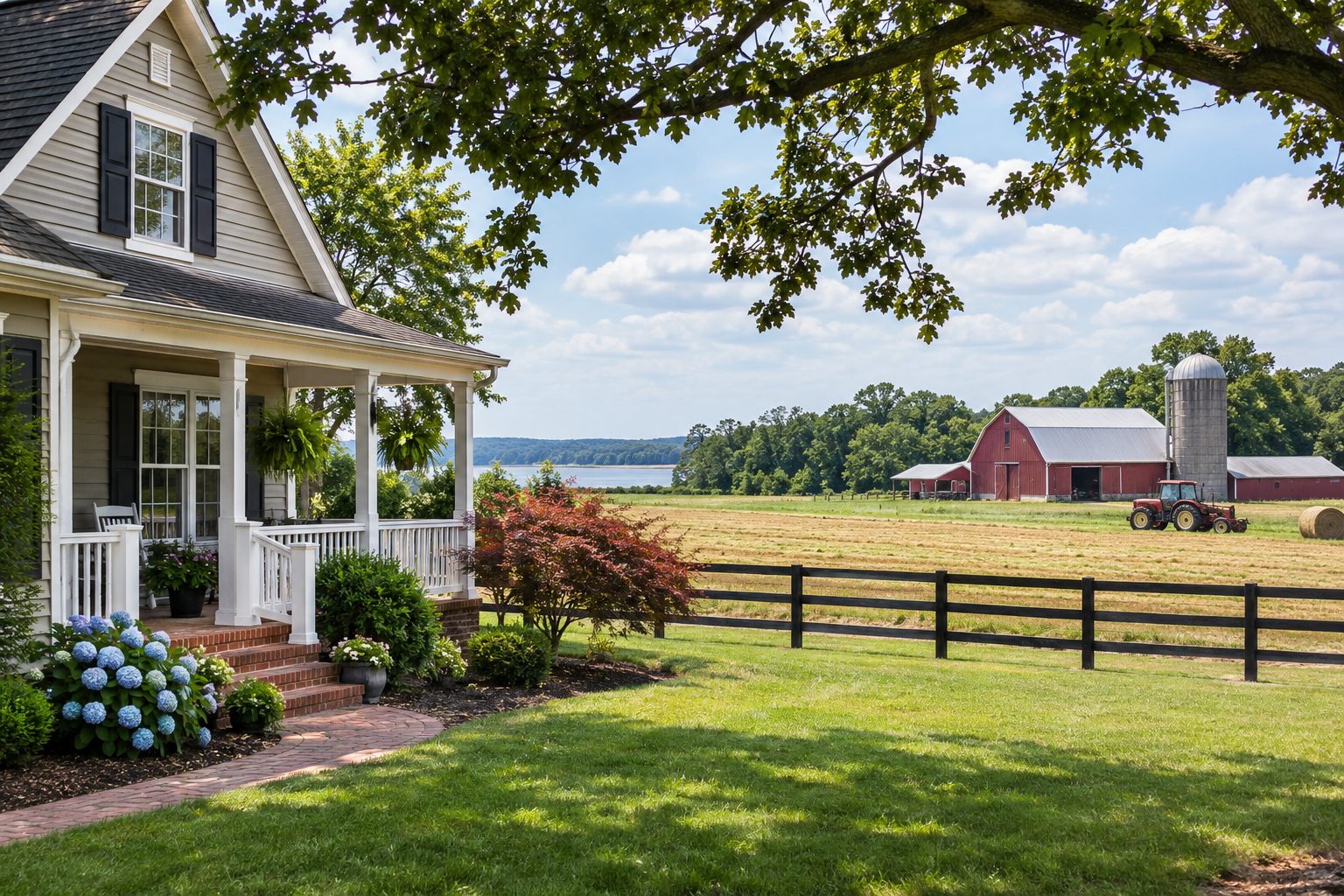
A working farm can provide open views and a strong sense of place, but it is also an active business. Equipment, animals, dust, odors, early hours, seasonal traffic and agricultural applications may be ordinary parts of the neighboring use.
Calvert County protects agricultural land through zoning and preservation programs. A beautiful field is not a promise that it will remain visually unchanged, and a preserved farm is not a quiet park with tractors added for atmosphere.
Dawn’s rule: Separate verified facts from assumptions. Then send each unresolved question to the professional or agency that controls the answer. A good contract strategy does not blur those roles.
Start with the property-specific question
A working farm can provide open views and a strong sense of place, but it is also an active business. Equipment, animals, dust, odors, early hours, seasonal traffic and agricultural applications may be ordinary parts of the neighboring use. That distinction matters because buyers and sellers often hear a shorthand answer and treat it as final. A listing description, seller memory, online map or contractor opinion can be useful, but none automatically controls title, financing, insurance, permitting or legal rights.
Calvert County protects agricultural land through zoning and preservation programs. A beautiful field is not a promise that it will remain visually unchanged, and a preserved farm is not a quiet park with tractors added for atmosphere. Dawn begins by writing down the client’s intended use, the evidence already available and the deadline for a reliable answer. That prevents research from becoming an open-ended project and keeps the parties focused on what could change price, terms or willingness to proceed.
Records buyers and sellers should collect
Documents usually reveal more than reassurance. Collect the following records early, preserve the original file names and note the source and date. If a record is missing, label it missing. Do not replace it with an assumption.
- Zoning and current land-use information
- Recorded agricultural-preservation easements and plats
- Deed covenants, access and shared-driveway rights
- Well and septic locations and records
- Survey and boundary markers
- Available notices about nearby agricultural operations
These records should be read together. A permit without a final inspection, a survey without the referenced easement, or an estimate without a defined scope can create false confidence. Dawn builds one shared checklist and tracks who requested each item, when it arrived and which professional still needs to review it.
Local warning signs that deserve a closer look
- The buyer assumes the field is unbuildable forever
- Farm access crosses the residential drive
- Well or septic lies near the boundary
- Odor and equipment are judged only during one quiet visit
- Fence ownership is unclear
- Future agricultural structures are ignored
A warning sign is not proof of a defect, denial or legal violation. It is a reason to slow down and ask a narrower question. The strongest due diligence says, “Here is what we observed, here is the controlling document or agency, and here is the answer we need before this date.”
In Calvert County, rural land, waterfront, private systems and community restrictions often overlap. One professional cannot answer every layer. A contractor may estimate a repair but cannot guarantee lender acceptance. A county employee may explain permits but not interpret a private contract. A Realtor can organize the transaction but does not replace legal, engineering, insurance or tax advice.
Verified rules and practical limits
- Agricultural and residential uses can be neighbors
- Preservation easements have specific terms
- Online maps are not surveys
- Right-to-farm protections do not answer every dispute
- Farm operations vary by season
- Buyers should visit at different times
These are starting points, not a substitute for a property-specific decision. Programs, forms and underwriting requirements can change. Dawn verifies the current rule with the controlling professional and keeps the written answer with the transaction file.
A practical buyer checklist
- Step 1: Review zoning and easements. Put the result in the transaction file and decide whether it changes affordability, intended use or the offer.
- Step 2: Walk the surveyed boundary. Put the result in the transaction file and decide whether it changes affordability, intended use or the offer.
- Step 3: Visit in different weather and hours. Put the result in the transaction file and decide whether it changes affordability, intended use or the offer.
- Step 4: Ask about access and fencing. Put the result in the transaction file and decide whether it changes affordability, intended use or the offer.
- Step 5: Inspect well and septic. Put the result in the transaction file and decide whether it changes affordability, intended use or the offer.
- Step 6: Discuss allergies, animals and lifestyle needs honestly. Put the result in the transaction file and decide whether it changes affordability, intended use or the offer.
Buyers should prioritize questions that can end the purchase, change the monthly cost or make the planned use impossible. Cosmetic preferences can wait. Title, financing, insurance, safety, legal use and expensive physical conditions cannot. The contract should preserve enough time to receive real answers rather than merely submit requests.
A practical seller checklist
- Seller action 1: Describe the view without promising permanence. Early documentation protects credibility and gives the seller more choices.
- Seller action 2: Disclose known access or boundary issues. Early documentation protects credibility and gives the seller more choices.
- Seller action 3: Provide survey and easement records. Early documentation protects credibility and gives the seller more choices.
- Seller action 4: Avoid minimizing normal farm activity. Early documentation protects credibility and gives the seller more choices.
- Seller action 5: Clarify fence maintenance. Early documentation protects credibility and gives the seller more choices.
- Seller action 6: Let buyers evaluate the setting. Early documentation protects credibility and gives the seller more choices.
Sellers gain leverage by solving uncertainty before a buyer turns it into a worst-case estimate. That does not mean repairing everything or agreeing with every concern. It means describing the property accurately, producing records quickly and understanding the likely cost and timing of any real issue before negotiating.
Related planning: Review Your Credit Score Can Change More Than the Mortgage Rate; Review The Holidays Reveal What You Really Need From a Home; Review Better Home Search Tools Still Need Local Judgment. These guides are designed to go live together, so the research, financing and negotiation questions connect.
How this issue can affect the transaction
| Area | Possible effect |
|---|---|
| Use | noise, odor and traffic may be seasonal. |
| Financing | easements and access need review. |
| Insurance | animals and fencing affect coverage. |
| Appraisal | adjacent use influences market reaction. |
| Title | preservation and access rights are recorded. |
| Marketability | the right buyer values the setting. |
| Seller net | accurate expectations reduce fallout. |
| Deadlines | easement and survey review take time. |
Not every possible effect will apply. The purpose of the table is to prevent tunnel vision. A buyer may solve a physical concern and still have a lender problem. A seller may agree to a credit and still lack insurable title or carrier approval. Each lane must reach its own answer.
Who should answer each part?
| Professional | What that professional should answer |
|---|---|
| Dawn Riley and the brokerage | Organize the transaction, explain contract mechanics, calendar deadlines and coordinate answers without replacing legal, lending, tax, insurance or technical advice. |
| Maryland real estate attorney or title professional | Interpret deeds, contracts, liens, ownership, recorded rights and legal remedies. |
| Lender and appraiser | Decide loan eligibility, borrower qualification, appraisal requirements and valuation treatment. |
| Inspector, surveyor or specialty professional | Evaluate physical conditions and measurements within the professional scope. |
| Insurance producer | Confirm coverage, exclusions, vacancy treatment, premiums and underwriting requirements. |
Dawn’s job is to make sure the correct question reaches the correct professional before the relevant decision date. She can explain the Maryland contract process, organize evidence and negotiate terms. She will not present a guess as a legal, underwriting, engineering, appraisal, insurance or tax conclusion.
A realistic Southern Maryland transaction example
A buyer loves a Sunderland home beside a preserved farm. We review the easement and zoning, confirm the property boundary and visit when normal farm work is occurring. The buyer chooses the home with eyes open, appreciating the view without expecting the neighboring business to behave like a wallpaper mural.
This example is illustrative, not a prediction. Property facts, contract language and professional decisions vary. What remains consistent is the method: identify the uncertainty, obtain the controlling evidence, calculate the effect and decide before leverage disappears.
How Dawn organizes the contract and negotiation strategy
I avoid value judgments about agriculture. I organize objective records, encourage real-world visits and make sure legal questions about easements or nuisance protections go to counsel.
Dawn Riley brings more than 25 years of Maryland real estate experience, detailed contract knowledge and Master Certified Negotiator training to that process. Her career includes 1,338+ sales and more than $532,653,786 in volume, with average sold-to-list statistics over 101%. Those numbers do not guarantee a result. They support a disciplined approach to pricing, documentation and negotiation.
Common mistakes to avoid
The first mistake is treating a verbal answer as a permanent fact. The second is asking the wrong professional to guarantee an outcome outside that person’s authority. The third is waiting until settlement week, when moving plans, rate locks and emotions make clear decisions harder.
Another mistake is assuming a credit cures everything. Money can address a known cost, but it does not create a permit, change a title right, make a lender approve the loan or force an insurer to issue coverage. The remedy must match the actual problem.
The Bottom Line
A working farm can provide open views and a strong sense of place, but it is also an active business. Equipment, animals, dust, odors, early hours, seasonal traffic and agricultural applications may be ordinary parts of the neighboring use. Collect the records, identify the controlling authority, calculate the transaction impact and protect the deadline. Buyers deserve enough evidence to make an informed decision. Sellers deserve a strategy that does not discount the property simply because information was disorganized.
Frequently Asked Questions
No. It can limit development rights, but farming methods, crops, structures and vegetation may change under the easement and zoning.
It is a legal framework protecting qualifying agricultural operations under specified conditions. Ask a Maryland attorney about a specific conflict.
Working farms can create seasonal odors, machinery, animals and early activity. Visit more than once.
No. Obtain a survey when boundaries or fences matter.
Review recorded easements and actual practice with title counsel.
Only if they burden or benefit it, but the neighboring easement still informs likely land use.
Yes, use the contract and applicable professional guidance for the specific property.
Ask the operator or appropriate agency about normal practices, while respecting privacy and avoiding unsupported assumptions.
Market reaction varies. Some buyers value open agricultural surroundings and others prefer separation from active operations.
She describes verified setting and rights accurately and gives buyers space to decide whether normal agricultural activity fits their life.
About Dawn Riley

Dawn Riley is an Associate Broker, Realtor, Master Certified Negotiator (MCNE) and Pricing Strategy Advisor (PSA) with The Riley Team at Deep Roots Real Estate in Huntingtown, Maryland. She has more than 25 years of real estate experience and additional negotiation coursework from Yale, Northwestern, UVA, Columbia and UC Davis. Dawn combines strategic pricing, advanced marketing and detailed Maryland contract knowledge for buyers and sellers throughout Calvert County and Southern Maryland.
Career results as of 2026: 1,338+ homes sold, $532,653,786+ in sales volume and average sold-to-list price statistics over 101%, per Bright MLS career production records. Past performance does not guarantee a specific result.
Dawn Riley
Associate Broker, Realtor, MCNE, PSA
The Riley Team at Deep Roots Real Estate
2425 Solomons Island Rd., Suite C, Huntingtown, MD 20639
410-414-2438
dawn@dawnriley.net
Schedule a consultation