Maryland New-Home Warranties and Punch-List Deadlines
RETURN TO BLOG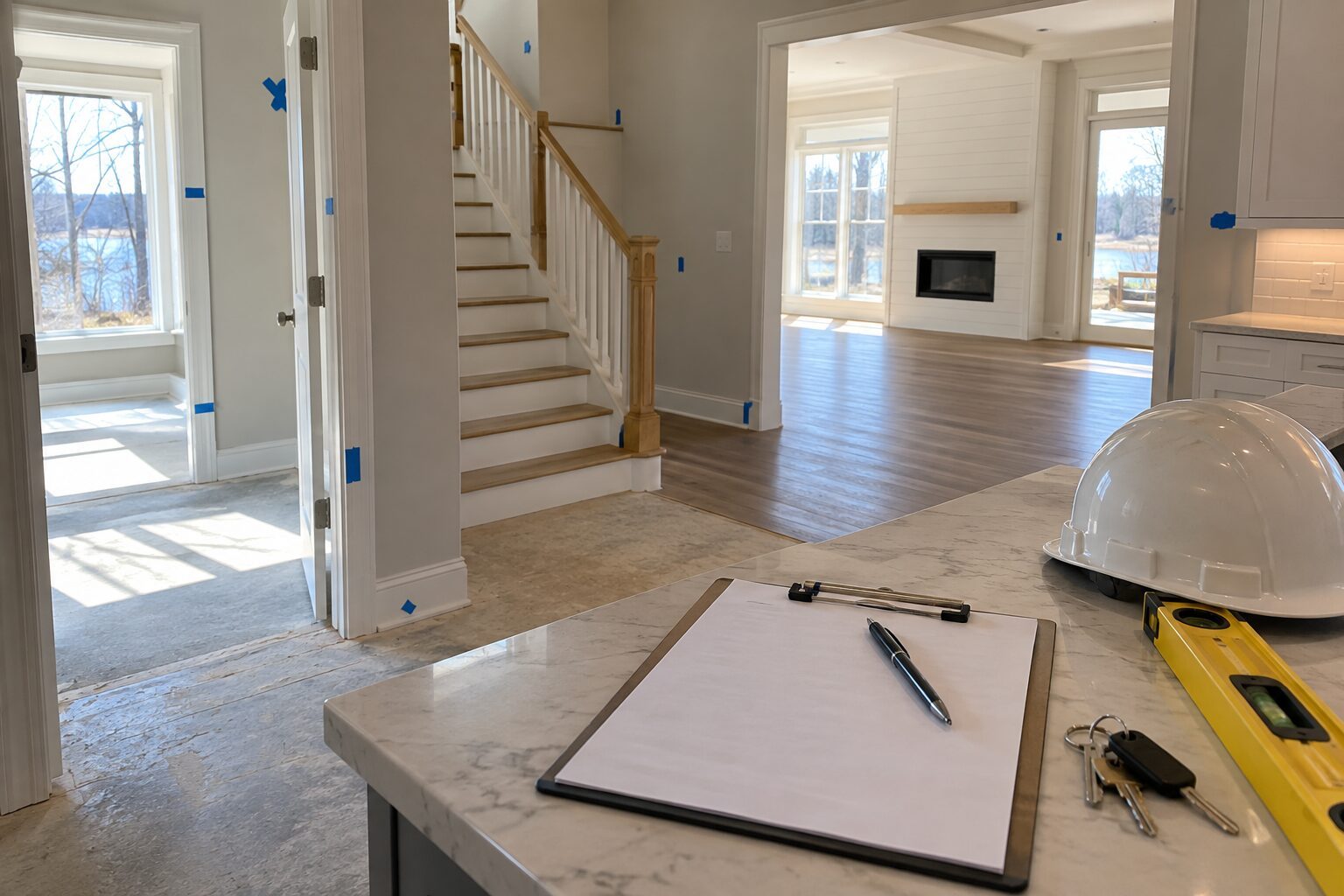
A municipal inspection, builder warranty, independent home inspection and cosmetic punch list serve different purposes. Maryland regulates home-builder registration and new-home warranty disclosures. Buyers should understand coverage, claim procedures, deadlines and unresolved work before accepting the home.
New construction in Calvert County may involve subdivision infrastructure, wells or public water, septic or sewer, stormwater features and architectural restrictions. A beautiful model does not answer lot-specific drainage, grading, orientation or option questions.
Dawn’s rule: Separate verified facts from assumptions. Then send each unresolved question to the professional or agency that controls the answer. A good contract strategy does not blur those roles.
Start with the property-specific question
A municipal inspection, builder warranty, independent home inspection and cosmetic punch list serve different purposes. Maryland regulates home-builder registration and new-home warranty disclosures. Buyers should understand coverage, claim procedures, deadlines and unresolved work before accepting the home. That distinction matters because buyers and sellers often hear a shorthand answer and treat it as final. A listing description, seller memory, online map or contractor opinion can be useful, but none automatically controls title, financing, insurance, permitting or legal rights.
New construction in Calvert County may involve subdivision infrastructure, wells or public water, septic or sewer, stormwater features and architectural restrictions. A beautiful model does not answer lot-specific drainage, grading, orientation or option questions. Dawn begins by writing down the client’s intended use, the evidence already available and the deadline for a reliable answer. That prevents research from becoming an open-ended project and keeps the parties focused on what could change price, terms or willingness to proceed.
Records buyers and sellers should collect
Documents usually reveal more than reassurance. Collect the following records early, preserve the original file names and note the source and date. If a record is missing, label it missing. Do not replace it with an assumption.
- Builder registration and corporate identity
- Signed construction or purchase contract with specifications
- Warranty plan, coverage, exclusions and claim procedures
- County permit and final inspection records
- Change orders, allowances and payment history
- Walkthrough punch list with photos and completion status
These records should be read together. A permit without a final inspection, a survey without the referenced easement, or an estimate without a defined scope can create false confidence. Dawn builds one shared checklist and tracks who requested each item, when it arrived and which professional still needs to review it.
Local warning signs that deserve a closer look
- The buyer relies only on the builder representative
- Verbal upgrades are absent from the contract
- Punch-list items lack deadlines or proof
- A certificate or final inspection is confused with quality assurance
- Warranty claim windows are not calendared
- Landscaping and drainage are accepted before observing performance
A warning sign is not proof of a defect, denial or legal violation. It is a reason to slow down and ask a narrower question. The strongest due diligence says, “Here is what we observed, here is the controlling document or agency, and here is the answer we need before this date.”
In Calvert County, rural land, waterfront, private systems and community restrictions often overlap. One professional cannot answer every layer. A contractor may estimate a repair but cannot guarantee lender acceptance. A county employee may explain permits but not interpret a private contract. A Realtor can organize the transaction but does not replace legal, engineering, insurance or tax advice.
A practical buyer checklist
- Step 1: Hire independent representation before selecting options. Put the result in the transaction file and decide whether it changes affordability, intended use or the offer.
- Step 2: Verify builder registration and warranty documents. Put the result in the transaction file and decide whether it changes affordability, intended use or the offer.
- Step 3: Order permitted independent inspections at key stages. Put the result in the transaction file and decide whether it changes affordability, intended use or the offer.
- Step 4: Compare installed items with specifications and change orders. Put the result in the transaction file and decide whether it changes affordability, intended use or the offer.
- Step 5: Document walkthrough findings with dates and photos. Put the result in the transaction file and decide whether it changes affordability, intended use or the offer.
- Step 6: Calendar warranty claims and submit them in writing. Put the result in the transaction file and decide whether it changes affordability, intended use or the offer.
Buyers should prioritize questions that can end the purchase, change the monthly cost or make the planned use impossible. Cosmetic preferences can wait. Title, financing, insurance, safety, legal use and expensive physical conditions cannot. The contract should preserve enough time to receive real answers rather than merely submit requests.
A practical seller checklist
- Seller action 1: For resale of a newer home, gather builder and warranty records. Early documentation protects credibility and gives the seller more choices.
- Seller action 2: Transfer warranties according to written procedures. Early documentation protects credibility and gives the seller more choices.
- Seller action 3: Disclose known defects and open claims. Early documentation protects credibility and gives the seller more choices.
- Seller action 4: Provide permits and completion evidence for owner changes. Early documentation protects credibility and gives the seller more choices.
- Seller action 5: Avoid promising transferable coverage without confirmation. Early documentation protects credibility and gives the seller more choices.
- Seller action 6: Price unresolved warranty work realistically. Early documentation protects credibility and gives the seller more choices.
Sellers gain leverage by solving uncertainty before a buyer turns it into a worst-case estimate. That does not mean repairing everything or agreeing with every concern. It means describing the property accurately, producing records quickly and understanding the likely cost and timing of any real issue before negotiating.
Related planning: Review Prequalification, Preapproval, and Conditional Mortgage Approval; Review Maryland Escalation Clauses and Competing-Offer Proof; Review Backup Offers and Kickout Clauses in Maryland. These guides are designed to go live together, so the research, financing and negotiation questions connect.
How this issue can affect the transaction
| Area | Possible effect |
|---|---|
| Use | unfinished or defective work can affect occupancy. |
| Financing | lender may require completion or appraisal updates. |
| Insurance | construction details and unresolved conditions affect coverage. |
| Appraisal | options and completion status influence value. |
| Marketability | organized warranty records help later resale. |
| Seller net | unresolved claims can become buyer negotiation items. |
| Deadlines | contract and warranty notice periods are separate. |
Not every possible effect will apply. The purpose of the table is to prevent tunnel vision. A buyer may solve a physical concern and still have a lender problem. A seller may agree to a credit and still lack insurable title or carrier approval. Each lane must reach its own answer.
Who should answer each part?
| Professional | What that professional should answer |
|---|---|
| Dawn Riley and the real estate team | Organize documents, identify contract deadlines, coordinate questions, compare offer terms and keep advice from each licensed professional in the correct lane. |
| Title company or real estate attorney | Review recorded instruments, ownership, liens, deed language, settlement charges and legal questions. Only an attorney should give legal advice. |
| Lender and appraiser | Decide loan eligibility, underwriting treatment, valuation requirements and documentation. A real estate agent cannot approve financing or direct an appraisal result. |
| Inspector, engineer or specialty contractor | Evaluate physical conditions within the professional scope and explain repair options. A general home inspection does not replace engineering or environmental review. |
| Insurance producer | Confirm whether coverage is available, what it costs, which exclusions apply and what underwriting records are required. |
Dawn’s job is to make sure the correct question reaches the correct professional before the relevant decision date. She can explain the Maryland contract process, organize evidence and negotiate terms. She will not present a guess as a legal, underwriting, engineering, appraisal, insurance or tax conclusion.
A realistic Southern Maryland transaction example
A buyer purchasing a new home near Prince Frederick finds grading, trim and appliance issues during the walkthrough. Dawn organizes the items by safety, contract specification and cosmetic completion, photographs each one and requests written target dates. The buyer inspector, county, lender and builder each answer only within their roles.
This example is illustrative, not a prediction. Property facts, contract language and professional decisions vary. What remains consistent is the method: identify the uncertainty, obtain the controlling evidence, calculate the effect and decide before leverage disappears.
How Dawn organizes the contract and negotiation strategy
Dawn treats the builder sales representative as the seller side. She tracks specifications, change orders, inspections, lender conditions and warranty delivery. Punch-list requests cite the contract or observed defect and demand clear completion evidence. Legal interpretation and warranty disputes go to an attorney or the appropriate state unit.
Dawn Riley brings more than 25 years of Maryland real estate experience, detailed contract knowledge and Master Certified Negotiator training to that process. Her career includes 1,338+ sales and more than $532,653,786 in volume, with average sold-to-list statistics over 101%. Those numbers do not guarantee a result. They support a disciplined approach to pricing, documentation and negotiation.
Common mistakes to avoid
The first mistake is treating a verbal answer as a permanent fact. The second is asking the wrong professional to guarantee an outcome outside that person’s authority. The third is waiting until settlement week, when moving plans, rate locks and emotions make clear decisions harder.
Another mistake is assuming a credit cures everything. Money can address a known cost, but it does not create a permit, change a title right, make a lender approve the loan or force an insurer to issue coverage. The remedy must match the actual problem.
The Bottom Line
A municipal inspection, builder warranty, independent home inspection and cosmetic punch list serve different purposes. Maryland regulates home-builder registration and new-home warranty disclosures. Buyers should understand coverage, claim procedures, deadlines and unresolved work before accepting the home. Collect the records, identify the controlling authority, calculate the transaction impact and protect the deadline. Buyers deserve enough evidence to make an informed decision. Sellers deserve a strategy that does not discount the property simply because information was disorganized.
Frequently Asked Questions
Maryland generally requires new-home builders to register with the Consumer Protection Division, subject to the law and limited jurisdictional exceptions. Buyers can verify the specific builder with the state unit.
No. A builder warranty and a separately purchased home service contract have different providers, coverage and claim rules. Read each document and do not rely on the marketing label.
Contract access controls, but buyers should negotiate appropriate independent inspection rights. County inspections enforce code requirements and do not replace a buyer-focused inspection.
Document incomplete, damaged or incorrectly installed items and compare them with plans, specifications and change orders. Use photos, locations and measurable descriptions.
The contract, lender, occupancy approval and written agreement control. Some minor items may remain, but material or lender-required work may need completion. Never rely on an unwritten promise.
The applicable statute and warranty plan define the warranty date and coverage. Buyers should obtain evidence of coverage and validated documents and calendar claim periods immediately.
Maryland law contains specific warranty and waiver provisions. Because the consequences are substantial, review the current statutory documents and obtain legal advice before waiving.
Follow the warranty notice procedure promptly, document the condition and allow required inspection. Serious safety, insurance or structural concerns may also need independent professional advice.
No. Appraisers analyze market evidence and completed features. Option cost, buyer preference and market contribution are different numbers.
She provides independent representation, tracks specifications and deadlines, organizes inspections and punch lists, and keeps builder, county, lender and warranty roles separate.
About Dawn Riley

Dawn Riley is an Associate Broker, Realtor, Master Certified Negotiator (MCNE) and Pricing Strategy Advisor (PSA) with The Riley Team at Deep Roots Real Estate in Huntingtown, Maryland. She has more than 25 years of real estate experience and additional negotiation coursework from Yale, Northwestern, UVA, Columbia and UC Davis. Dawn combines strategic pricing, advanced marketing and detailed Maryland contract knowledge for buyers and sellers throughout Calvert County and Southern Maryland.
Career results as of 2026: 1,338+ homes sold, $532,653,786+ in sales volume and average sold-to-list price statistics over 101%, per Bright MLS career production records. Past performance does not guarantee a specific result.
Dawn Riley
Associate Broker, Realtor, MCNE, PSA
The Riley Team at Deep Roots Real Estate
2425 Solomons Island Rd., Suite C, Huntingtown, MD 20639
410-414-2438
dawn@dawnriley.net
Schedule a consultation